Showing posts with label investment strategy. Show all posts

Thursday, September 3, 2015

Market Volatility - My Letter To Our Clients

This is a letter that I sent to our clients on August 22, 2015, to address the current market volatility. 

"Our goal is to help people overcome their worries and concerns about money and investing so that they have more time to focus on what's most important to them."

That's a quote from a marketing brochure that Simone and I put together when we started our business back in 2007. Although we haven't used those brochures for years, that sentence still summarizes what I try to do for each of our clients. My sincere hope is that the financial planning we've done has reduced your financial worries and brought more enjoyment to your life.

I'm writing this to address last week's volatility. I realize that even if our clients don't pay attention to the day-to-day movement of their investments (which is never a good idea!), it's impossible to escape the constant barrage of negative headlines that accompany market downturns. This is my response to all of the do-something-now-before-it's-too-late-this-time-is-different articles that you'll come across now and in the future.

I thought it might be helpful to put together a list of the main points that I'd like to make about why we do what we do. This would probably be easier to follow than writing it in paragraph form, and it would be something that you could refer to easily in the future.

In addition to reviewing the list below, I think it would wise to reread all of the Company Updates, Client's Corner, and other articles that I've uploaded to your web portal during the time that we've worked together. These documents were selected to reinforce what we discuss during meetings. It would also be helpful to review past meeting agendas, your meeting notes, financial plans, etc. 

Problem: It's impossible to predict the future.
Solution: Develop a financial plan and update it as needed.

The good news for clients reading this is that your financial plan has prepared you for things like the volatility we experienced last week. During the planning process we discuss what might happen in the future and then built an investment strategy to prepare for it so you don't have to react every time the market swings.

Problem: It's impossible to time the market.
Solution: Stay invested, focus on the long-term, and don't panic and sell during downturns.

Was the downturn last week the start of a new bear market? Or was it just a short-term overreaction to current events? Only time will tell, but reacting to it is the wrong thing to do. Getting out of the market or reducing your stock exposure in response to downturns might feel like a good strategy, but it's a sure way to turn a decline in value into a realized loss. There's no shortage of studies showing that market timing leads to increased costs, higher taxes, and lower performance.

Problem: It's impossible to pick the best investments.
Solution: Select diversified, passively-managed mutual funds and ETFs.

Just like it's impossible to predict the short-term direction of the market, it's also impossible to predict which individual stocks or bonds will do best at any given time. You can eliminate the risk of losing a large percentage of your portfolio in a single holding by investing across a diversified portfolio consisting of thousands of stocks and bonds. Even professional fund managers fail to beat their respective benchmarks. Only around 1 in 5 mutual funds outperform over 10+ year time periods, and it's impossible to know which fund will outperform in advance. Selecting mutual funds and ETFs that track an index of stocks and bonds - instead of trying to pick the best individual holdings - helps make sure that you get as much of the market's return as possible.

Problem: The stock market is volatile.
Solution: Don't put short-term money in the stock market.

It's a fact that the stock market is volatile. It's also a fact that you can't lose money in stocks if you avoid selling when stocks are down. Although there's never a guarantee, you can limit the chance that you'll have to sell stocks during a downturn through regular planning. For clients that aren't retired, we regularly review their cash reserve to make sure they shouldn't have to touch their investments for an emergency expense. For retirees, we regularly review their spending needs and withdrawal strategy to make sure they have enough in cash and bonds to support their projected spending needs in a downturn.

Problem: Your money is worth less each day.
Solution: Invest for long-term growth.

Some individuals avoid the volatility of the stock market in favor of "safe" investments like cash and bonds. A common misconception about these types of holdings is that at least this money will be "safe," but that's not true. I believe that inflation is a larger danger to investors than volatility, especially since it's a danger that many don't "see" until it's too late to do anything about it. For example, retirees that don't get enough growth to outpace inflation might have to make huge reductions in their spending later in life.

So to summarize these points, your financial plan and investment portfolio were designed with market events like last week in mind. Reacting to these events might make you feel better over the short-term, but could do permanent harm to your financial situation.

Please contact us if you have any questions or concerns about the funds we manage for you. Likewise, let us know if your financial needs or goals change.

Best regards,

Neil

To learn more about our company - and find out how we are different from other financial advisors - call (210) 587-6433 or visit www.VannoyAdvisoryGroup.com.

Monday, September 8, 2014

What Would You Say You 'Do' Here?

One of my favorite scenes in the movie Office Space is when Tom Smykowski is interviewed by the consultants hired to help Initech downsize. During the interview it becomes painfully obvious that his position isn't necessary. When he's finally asked point blank, “What would you say you do here?”, Tom replies, “…I have people skills! I am good at dealing with people! Can’t you understand that?!?

As an investor it’s important to look at each of your holdings like a consultant and ask what it’s doing in your portfolio. Each investment should have a clearly identifiable role in the overall risk/return of your portfolio. This post covers some of the asset classes commonly used in portfolios to see what they might do to affect a portfolio's return potential.

The portfolio mixes discussed are for educational purposes only and are not recommendations. The portfolios are divided evenly between the investments used in each example and are rebalanced annually.

US Stocks

I tend to think of large-cap US stocks as the first building block of an investment portfolio, so that’s where I’ll start. An investment in Vanguard 500 Index (VFINX) — a mutual fund designed to track the S&P 500 index, one of the more popular benchmarks for large-cap US stocks — would have earned an annualized return of 7.66% for the 10-year period ending June 30, 2014.

The next asset class we might consider adding to our portfolio is small-cap US stocks. Although they tend to be more volatile, stocks of smaller companies have historically outperformed large-cap stocks.

One of the more cost-effective ways to add small-cap stocks to your portfolio is to use a mutual fund that invests in the entire US stock market like Vanguard Total Stock Market (VTSMX) instead of using a separate small-cap stock fund. The average annual return of Vanguard Total Stock Market was 8.31% for the 10-year period ending June 30, 2014, which is 0.65% more per year than Vanguard 500 Index.

International Stocks

Although they’ve underperformed US stocks recently, as a long-term investor it’s a good idea to consider having international stocks in your portfolio. Not only could you benefit during times when international markets outperform the US market, but you could also benefit from international investments if the dollar declines against other currencies. For this asset class I’ll use DFA Large Cap International (DFALX) which invests in large-cap stocks in developed international countries.

Moving 50% of our portfolio to DFA Large Cap International and keeping the other 50% in Vanguard Total Stock Market for large- and small-cap US stock exposure would have earned 7.80% per year from June 2004 through June 2014. Although this mix produced a lower return than Vanguard Total Stock Market by itself, splitting your portfolio evenly between these two funds did produce better results than only holding an S&P 500 index fund over the same timeframe.

Emerging Market Stocks

Emerging markets like Brazil, India, and China don’t always move in lockstep with developed markets, so adding emerging market stocks could be a great way to diversify your portfolio. For this asset class I'll use DFA Emerging Markets (DFEMX).

A portfolio with one-third in Vanguard Total Stock Market, one-third in DFA Large Cap International, and one-third in DFA Emerging Markets would have averaged 9.45% per year through June 2014. This is 1.14% more per year than Vanguard Total Stock Market and a whopping 1.79% more per year than Vanguard 500 Index!

Real Estate Investment Trusts (REITs)

Many investors consider REITs to be an important addition to a portfolio. The historical return from REITs has been similar to large-cap US stocks, but REITs offer great diversification benefits since they don't move in tandem with the overall stock market.

Moving 25% of your investment assets to Vanguard REIT Index (VGSIX) — while holding 25% in US stocks, international stocks, and emerging market stocks — would have increased our theoretical 10-year average annual return to 9.76%. That’s quite a boost over a portfolio of only large-cap US stocks!

Value Investments

The last thing I’d like to do to our hypothetical portfolio is to add separate holdings for US and international small-cap value stocks. For domestic small-cap value stocks I’ll use DFA US Small Cap Value (DFSVX) and for international small-cap value stocks I'll use DFA International Small Cap Value (DISVX).

Just like small-cap stocks offer a higher return potential than large-cap stocks, value stocks have historically outperformed the market as a whole. But in order to capture the potentially higher returns from small-cap and value stocks, you have to be patient enough to hold them for the long-term. And this can be difficult to do when other segments of the market are outperforming value stocks.

So our final theoretical portfolio is evenly divided between Vanguard Total Stock Market Index, DFA Large Cap International, DFA Emerging Markets, Vanguard REIT Index, DFA US Small Cap Value, and DFA International Small Cap Value. This mix would have generated an average annualized return of 9.91% from June 2004 through June 2014, surpassing all of the other mixes we've discussed.

You can see that each of the mutual funds in this hypothetical portfolio serves a specific purpose. They each each represent a specific asset class — or a segment of the market with higher potential return in the case of DFA US Small Cap Value — and mixing them together is a way to have something that “zigs” when other holdings “zag.”

Don’t make the mistake of thinking that you’re diversified just because you have several different holdings. Take time to review each investment you have and ask, “What would you say you do here?”

To learn more about our company - and find out how we are different from other financial advisors - call (210) 587-6433 or visit www.VannoyAdvisoryGroup.com.

Investments mentioned in this post and throughout this blog are for educational purposes only and are not recommendations. Seek investment advice from your personal financial advisor before making any investments.

Sunday, April 20, 2014

Who Moved My Small-Cap Fund?

Actively-managed mutual funds have a lot of flexibility over the types of investments they hold. One problem with this flexibility is that it often leads to style drift, which is a term used to describe a gradual change in investment style within a fund. Style drift is important to understand since a change in the investment style of a single fund could change the expected risk and return of your overall portfolio.

I wasn’t concerned about style drift when I first started investing. I believed that a good active manager could outperform the market by changing investment styles as the market changed. However, after years of trial and error - and stumbling across the efficient-market hypothesis in 2005 - and realized that style matters much more than skill.*

Avoiding style drift is one of the many reasons investors select index funds over actively-managed funds. Since index funds track specific indexes, their holdings and investment strategies are completely transparent. Managers of index funds aren’t able to change the investment style since they are required to replicate the performance of the index they follow.

For example, an index fund that tracks the S&P 500 Growth Index isn’t going to start to invest in emerging market stocks because the manager thinks they look cheap relative to US stocks. Likewise, a mutual fund that tracks the MSCI World ex-USA All Cap Index isn’t going to hold US stocks. With a portfolio of index funds, you’re in control of how much exposure you have in a specific asset class. And not having to worry about style drift in your portfolio helps you keep the hot side hot, and the cool side cool.

Okay. So now that I’ve told you that you don’t have to worry about style drift in your index funds, I’m now going to explain why you have to worry about style drift in your index funds. Confused? I’ll explain.

Let’s consider US small-cap stock indexes to illustrate how an index fund might drift off course. There are several indexes that track US small-cap stocks, and each individual index has a specific set of criteria to determine what constitutes a “small-cap stock.” The stocks of companies that meet the criteria will be added to the index, and the mutual funds that track that index will be required to buy that company’s stock. In the same manner, index funds have to sell stocks that are removed from an index.

Instead of having strict breakpoints to define “small-cap”, many indexes have bands that allow the index to continue to hold a stock after it migrates out of the small-cap portion of the market. This happens when a small company continues to grow and enters the “mid-cap” area of the market. The basic idea behind bands in an index is to reduce turnover and trading costs for the mutual funds that track that index.

Certain indexes from the Center for Research in Security Prices (CRSP) use bands instead of breakpoints. (You can read more about banding and migration at the CRSP website here.) Vanguard recently changed the indexes that many of their funds follow to CRSP indexes, and this index change resulted in a style change for the Vanguard Small-Cap Index mutual fund.

The table to the left shows the percentage of stocks in the Vanguard Small-Cap Index fund that were considered large-cap (L), mid-cap (M), and small-cap (S) as of 2/28/14. At that time, only 54% of the fund’s holdings were classified as small-cap stocks.

Dimensional Fund Advisors (DFA) is another provider of index funds. Unlike Vanguard, DFA offers funds only through approved financial advisors. After years of following their research, I was recently granted access to DFA funds for myself and for clients. We’re now in the process of updating client portfolios to include DFA funds where appropriate.

The table to the right shows the holdings of the DFA US Small-Cap mutual fund as of 2/28/14. The fund held 91% of its assets in small-cap stocks, much more than the Vanguard fund that tracks the same segment of the market.

The average market cap (i.e. company size) of the two funds helps illustrates how different they are. Vanguard Small-Cap had an average market cap of $2.87 billion on 2/28/14. The market cap for the DFA fund at that time was $1.45 billion, or 49.5% smaller than the Vanguard Small-Cap fund.

So when it comes to US small-cap stock funds, my opinion is that DFA US Small-Cap is a much better option than Vanguard Small-Cap. Both are index funds, but the DFA fund keeps a much stronger exposure to small-cap stocks and their potential to outperform larger stocks over time.

*A few years ago I gave some background into my transition away from active management in a post titled “To Index, Or Not To Index: That Is The Question.”

To learn more about our company - and find out how we are different from other financial advisors - call (210) 587-6433 or visit www.VannoyAdvisoryGroup.com.

Monday, October 7, 2013

The Importance Of Stock Dividends

Stock returns come from two sources: capital gains and dividends. A capital gain occurs when a stock you purchase appreciates in price. Dividends are payments made directly to shareholders and are not affected by the day-to-day changes of a stock's price.

Capital gains tend to be the most exciting portion of stock returns since stock prices fluctuate daily, but dividends have the potential to make a huge difference in your total return over time. 

Price Return vs. Total Return

Return figures of indexes like the S&P 500 are often based on the "price return" that only includes price changes of the index (i.e. capital gains or losses). The "total return" figure also includes the dividends that were been paid out by the companies in the index.

The S&P 500 averaged a total return of 9.7% per year over the past 40 years. With dividends removed the return falls to 6.4% per year. So over the past 40 years dividends made up around 1/3 of the total return of large US stocks.

S&P 500 Returns (12/31/1972 – 12/31/2012)
With Dividends
9.7% Per Year
Without Dividends
6.4% Per Year

To put this into perspective, a $10,000 investment would grow to over $400,000 if it compounded at 9.7% per year over 40 years. That same investment would only be worth around $120,000 if it grew at 6.4% per year. That’s a huge difference and illustrates the impact of letting stock dividends compound over time.

Initial Investment Of $10,000 Over 40 Years
@ 9.7% Per Year
$405,756
@ 6.4% Per Year
$119,582
*For educational purposes only and does not take into account taxes, investment costs, and other fees.
 
How To Profit From Dividends

Hold Value Investments – Adding “value” investments to your portfolio can increase your dividend income since they tend to pay more dividends than “growth” investments. Keep in mind that growth and value tend to fall in and out of favor over time, so you might want to have a mix of both in your portfolio.

Don’t React to Market Swings – Instead of panicking out of stocks during downturns, focus on the fact that you’re able to buy shares at a discount with your dividend income. And remember that you won't receive the dividends if you sell your stocks during the downturn.

Be Careful Of Equity-Indexed Products – Some advisors sell annuities and insurance that promise “equity returns” without losses. Unfortunately most of these products use the “price index” that leaves out dividends, so your long-term expected return will be much lower than you might think.

To learn more about our company - and find out how we are different from other financial advisors - call (210) 587-6433 or visit www.VannoyAdvisoryGroup.com

Monday, September 9, 2013

3 Things To Consider With Rising Interest Rates

There has been a lot of coverage in the news recently about the Fed’s decision to raise interest rates. With the recent history of record-low rates, it may be difficult to remember that periods of rising rates are normal. In fact, rising rates can create opportunities for investors. So how can you take advantage of the current interest rate climate?

1. Buy Stocks. 

Since 1970, there have been 21 periods where the 10-year rate moved a whole percentage point. The S&P 500 had a positive return for 15 of those 21 periods.

Yes, every market is unique, and every spike in interest rates can be due to a wide range of influences. Generally speaking, however, increasing rates will cause investors to sell bonds and buy stocks. Bond prices move inversely with interest rates, so as rates go up, prices come down. Long periods of low rates indicate high relative prices for bonds. When prices start to come down, investors look for more attractive investments. The increase in demand raises stock prices.

2. Rebalance Your Portfolio.

Interest rates affect an organization’s ability to borrow and pay back debt. Low rates improve the ability to pay back loans, so companies borrow more. The increased funds create more spending, which drives corporate development. When rates go up, the concern is that companies will be less likely to borrow. This concern affects pricing within the market.

When market prices are impacted from Fed activity, the movements are typically erratic. The reason for this is that changes in interest rates can create uncertainty, which leads to volatility. The more volatile a market, the more opportunities there are for an investor to buy low and sell high. Active investors can benefit from buying during down swings and selling during peaks.

3. Diversify Your Bonds.

Corporate Bonds – Higher rates are not necessarily bad for companies. An increase in value of a company’s equity (which we’ve seen in times of rising rates) improves a company’s credit quality. This positively affects the value of the company’s debt. Corporate bonds are impacted much more by the company’s financials than external factors.

Short-Term Bonds – Changing interest rates can create opportunities in bonds with different maturities. Shorter duration bonds are typically less sensitive to changes in interest rates. This is primarily because there is less exposure to the long-term effects from Fed activity. A strategy that uses short-term fixed income gives investors the ability to capitalize on rate movements. When these bonds mature, the principal can be reinvested at the higher rates.

Global Bonds – Foreign bonds can be a great way to diversify your U.S. investments. Interest rates in each nation are driven by different factors. By taking a look at the entire global landscape, investors can uncover other opportunities within the bond market. At the same time, investors who diversify can avoid the potential impact of a continuing rise in U.S. rates.

This is a guest post by Kyle Brennan. Kyle is a financial author, specializing in SEO and copywriting services for investment advisors. He received his MBA and MS from Creighton University and is a Level III Candidate with the CFA Institute. If you’d like to contact him, please e-mail kylembrennan@gmail.com.

To learn more about our company - and find out how we are different from other financial advisors - call (210) 587-6433 or visit www.VannoyAdvisoryGroup.com.

Tuesday, May 29, 2012

Investing On Margin (Beware The Double-Edged Sword!)

Investing on margin is similar to purchasing a home. Most home buyers borrow money to be able to purchase a larger home than they could afford if they had to pay cash for the entire purchase price. Investors that use margin borrow money to increase the amount of stocks they're able to buy.

The primary reason investors use margin is to increase their investment returns. Unfortunately, using margin can work against you just as easily as it can work in your favor.

Investing Without Margin

Let's start by looking at an investment made without the use of margin. Assume you purchase 100 shares of ABC Industries when it's trading at $50 per share. Your total investment would be $5,000 (100 shares x $50 per share = $5,000 investment).

Assume the stock price of ABC Industries climbs to $55 per share and you sell your total holdings for $5,500 (100 shares x $55 per share = $5,500 proceeds). This would give you a profit of $500 ($5,500 proceeds - $5,000 investment = $500 profit) which represents a 10% gain on your initial investment ($500 profit / $5,000 investment = 10% gain).

Using Margin To Magnify Gains

Now let's assume you used margin for your initial investment in ABC Industries. Assume you invest $2,500 of your own money and borrow $2,500 from your brokerage firm for the initial investment. You then purchase the same 100 shares for a total of $5,000 (100 shares x $50 per share = $5,000 investment).

You would still realize a profit of $500 if ABC Industries climbs to $55 per share and you sold your shares (100 shares x $55 per share = $5,500 proceeds - $5,000 initial investment = $500 profit). However, due to the fact that you only used $2,500 of your own money, that $500 profit now represents a 20% gain on your money ($500 profit / $2,500 investment = 20% gain).

In this scenario, borrowing 50% of the initial purchase amount doubled your gain from 10% to 20%! Of course in the real world you'd pay interest on the money you borrow and might pay trading commissions, but you'd still end up better for using margin in this scenario.

Stocks Don't Always Go Up 

Margin is a double-edged sword. Using margin is great when stocks go up, but even a small drop in price could be enough to wipe out your initial investment if you are using a lot of margin.

To illustrate this risk, assume you purchase 100 shares of ABC Industries on margin at $50 per shares as you did in example above, but this time the price of the stock declines. You would realize a -$500 loss if you sold your holdings when ABC Industries was at $45 per share (100 shares x $45 per share = $4,500 proceeds - $5,000 investment = -$500 loss).

You only invested $2,500 of your own money since you borrowed 50% of the initial investment using margin, but this loss now represents a 20% loss on your investment because you used margin (-$500 loss / $2,500 investment = -20% loss)! Investing on margin looks great when stocks go up, but it doesn't take much of a price decline to realize how dangerous using margin can be!

Some Of The Risks Associated With Buying On Margin

(1) Stocks don’t always go up – Using margin magnifies your losses when stocks decrease in value.

(2) You can lose more than you deposit – If the securities you purchase decline in value, you may be required to deposit additional funds to cover the losses. This is called a margin call.

(3) Your brokerage firm can force the sale of securities – If you are required to deposit cash to cover your losses, your brokerage firm has the right to sell securities in your account to meet the margin call if you don’t deposit money in time.

(4) You pay interest even if you lose money – Interest will be charged on your margin balance whether or not you make money on the trade, and paying interest to lose money just adds insult to injury!

Using margin as a way to increase returns is one of the biggest mistakes that investors make. Make sure you know what you're doing - and understand all of the risks involved - before using margin in your accounts.

To learn more about our company - and find out how we are different from other financial advisors - call (210) 587-6433 or visit www.VannoyAdvisoryGroup.com.

Monday, February 21, 2011

Five Rules for Investment Success

Rule 1: Lower Your Investment Costs

Rather than wasting time worrying about things beyond your control - like the direction of the stock market, interest rates, or inflation - focus on things you can control in order to improve your odds of investment success. A simple thing to control is the cost of your investments.

You can reduce your investment costs by choosing “no load” mutual funds over funds that pay sales commissions. After all, how does paying a 5.75% upfront commission improve the odds that a fund will make you money? Another easy way to control your costs is to select mutual funds with lower than average expense ratios. (You can read more about mutual fund expenses and fees in a previous post here).

Rule 2: Know What You're Paying for Advice

Another thing you can control in the investment world is how much you're paying for financial advice. Make sure your advisor discloses all sources and amounts of income so you know exactly what you're paying. You might be surprised at how much the "free advice" you receive from your broker is costing you! (FYI - The hidden costs (i.e. sales commissions) of annuities and life insurance can be especially high.)

You can avoid hidden costs by working with a "fee-only" advisor. Unlike advisors that use the term "fee-based", "fee-only" advisors are paid directly by their clients, never receive sales commissions, and have an incentive to recommend low cost investments and insurance. (See if your advisor would be willing to sign a Fiduciary Statement like the one I use here.)

Rule 3: Ignore Your Emotions

All of us are familiar with the saying “buy low, sell high”, but following your emotions when you invest usually leads to doing the opposite. Think twice before going along with the crowd during manias like the dot-com boom and avoid panicking during market declines. Make sure you follow a clearly defined investment strategy so you can take emotions off of the table when making investment decisions.

Rule 4: Don’t Forget About Taxes

Whether or not you realize it, you have an investment partner involved in every decision you make: Uncle Sam. In addition to taxable investment accounts, make sure you're using tax-favored accounts like 401(k)s, 403(b)s, Traditional IRAs, and Roth IRAs whenever possible.

For most investors it makes sense to have a combination of "tax-deferred" accounts (e.g. 401(k), 403(b), Traditional IRA) and "tax-free" investment vehicles (e.g. Roth IRA, Roth 401(k)) in order to balance current and future tax savings. Keep in mind that Uncle Sam won't forget about you later in life!

Rule 5: Understand Risk

All investments involve risk. If you invest in stocks, you face the risk that stock prices could tumble. If you hold more stable investments like bonds and CDs, you face the risk that the return you receive won’t keep up with inflation over time.

That’s why most investors diversify into a mix of different types of investments. Make sure you understand and are comfortable with the risk you’re taking with each individual investment as well as with your portfolio as a whole.

To learn more about our company - and find out how we are different from other financial advisors - call (210) 587-6433 or visit www.VannoyAdvisoryGroup.com

Tuesday, February 15, 2011

Sizing Up Your Retirement Nest Egg Need

One of the biggest mistakes I see people making in their retirement planning is underestimating how much a secure retirement costs. In fact, most people don’t have any idea how much they'll need to have saved to be able to retire comfortably.

How much income will you need in retirement?

The first step to determining how much you need to save is to estimate your annual income need in retirement. A simple way to do this is to start by figuring out how much you spend each year to support your current lifestyle.

Once you get this figure, subtract expenses you won’t have when retired (like retirement savings and expenses for your children) and then add expenses you might incur (like money for additional travel or increased health care costs).

That should give you a rough idea of what you’ll need to retire in today’s dollars.

How large does your nest egg need to be?

Withdrawals from your nest egg will be needed to cover any shortfall between your retirement spending and any steady income you’ll have from things like Social Security, pensions, fixed annuities, and part-time work. For example, assume you’ll need $50,000 in retirement income and will receive $18,000 per year from Social Security. This leaves an income gap of $32,000 per year.

$50,000 Income Need – $18,000 Social Security = $32,000 Income Gap

To get a rough idea of how large your nest egg needs to be, simply multiply this gap by 25. This will calculate how much you need to have saved to cover the income gap at a 4% withdrawal rate.

$32,000 Income Gap x 25 = $800,000

In this case you’d need around $800,000 to produce the extra income you need assuming you withdraw 4% of this amount per year.

What about inflation?

These calculations estimate how much retirement income and how large of a nest egg you'd need in today's dollars. However, since the cost of everything we buy increases over time, these numbers will have to be increased by at least 3 to 4% each year to keep up with inflation.

To learn more about our company - and find out how we are different from other financial advisors - call (210) 587-6433 or visit www.VannoyAdvisoryGroup.com

Monday, August 2, 2010

Is Buy and Hold Dead?

Adherents to a “buy and hold” investment strategy believe that the best way to invest is to hold a diversified portfolio of different asset classes over a long time frame. Here is a simplification of the buy and hold investment process:

1. Analyze your goals, risk tolerance, time horizon, etc.,
2. Select an appropriate asset allocation (mix of asset classes),
3. Select individual investments to use for each asset class,
4. Regularly rebalance your portfolio back to the original asset allocation, and
5. Change the asset allocation as your goals, time horizon, etc. change.

The problem with buy and hold - as with any investment strategy - is that there are times when it doesn’t work. Even with all dividends reinvested, a $10,000 investment in theS&P 500 on March 24, 2000 would only be worth $8,510 as of July 12, 2010!

That’s the kind of performance that has many people declaring that buy and hold is dead.

Performance of the S&P 500 Index*
(10 Years Ending 7/14/10)
The chart above shows the performance of the S&P 500 index over the past 10 years. You can see that while the “buying” part might be easy, it’s the “holding” part that can test your nerves.

Believe it or not, even though the S&P 500 is still in negative territory, other asset classes have had positive growth over the past decade. A properly diversified portfolio with exposure to US small-cap, developed international, and emerging market stocks, bonds and REITs would have realized positive returns over the past 10 years.*

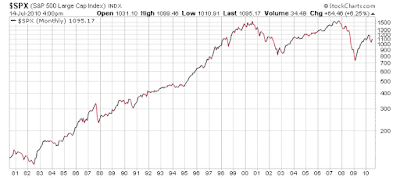
Even if you had only invested in the S&P 500 over the past 30 years - a strategy I certainly wouldn’t recommend! - you would have still made money if you had been patient enough to ride out the ups and downs. The chart below shows the S&P 500 index over the past 30 years.

Performance of the S&P 500 Index*
(30 Years Ending 7/14/10)

Many people view the negative performance of the S&P 500 over the past 10 years as proof that buy and hold will never work again. This viewpoint is shortsighted, in my opinion, because no single investment strategy can be expected to outperform all of the time.

In fact, buy and hold actually worked over the past 10 years for asset classes other than large US stocks. The moral of the story is to hold a diversified portfolio with multiple asset classes, rebalance regularly, and avoid bailing out at the first sign of trouble.

Buy and hold is an excellent strategy as long as you are aware of, and comfortable with, the pros and cons associated with it.

To learn more about our company - and find out how we are different from other financial advisors - call (210) 587-6433 or visit www.VannoyAdvisoryGroup.com.

*The performance figures and charts in this post are for informational purposes only. Past performance can't and shouldn't be used to predict future returns.