This is a letter that I sent to our clients on August 22, 2015, to address the current market volatility.
"Our goal is to help people overcome their worries and concerns about money and investing so that they have more time to focus on what's most important to them."
That's a quote from a marketing brochure that Simone and I put together when we started our business back in 2007. Although we haven't used those brochures for years, that sentence still summarizes what I try to do for each of our clients. My sincere hope is that the financial planning we've done has reduced your financial worries and brought more enjoyment to your life.
I'm writing this to address last week's volatility. I realize that even if our clients don't pay attention to the day-to-day movement of their investments (which is never a good idea!), it's impossible to escape the constant barrage of negative headlines that accompany market downturns. This is my response to all of the do-something-now-before-it's-too-late-this-time-is-different articles that you'll come across now and in the future.
I thought it might be helpful to put together a list of the main points that I'd like to make about why we do what we do. This would probably be easier to follow than writing it in paragraph form, and it would be something that you could refer to easily in the future.
In addition to reviewing the list below, I think it would wise to reread all of the Company Updates, Client's Corner, and other articles that I've uploaded to your web portal during the time that we've worked together. These documents were selected to reinforce what we discuss during meetings. It would also be helpful to review past meeting agendas, your meeting notes, financial plans, etc.
Problem: It's impossible to predict the future.
Solution: Develop a financial plan and update it as needed.
The good news for clients reading this is that your financial plan has prepared you for things like the volatility we experienced last week. During the planning process we discuss what might happen in the future and then built an investment strategy to prepare for it so you don't have to react every time the market swings.
Problem: It's impossible to time the market.
Solution: Stay invested, focus on the long-term, and don't panic and sell during downturns.
Was the downturn last week the start of a new bear market? Or was it just a short-term overreaction to current events? Only time will tell, but reacting to it is the wrong thing to do. Getting out of the market or reducing your stock exposure in response to downturns might feel like a good strategy, but it's a sure way to turn a decline in value into a realized loss. There's no shortage of studies showing that market timing leads to increased costs, higher taxes, and lower performance.
Problem: It's impossible to pick the best investments.
Solution: Select diversified, passively-managed mutual funds and ETFs.
Just like it's impossible to predict the short-term direction of the market, it's also impossible to predict which individual stocks or bonds will do best at any given time. You can eliminate the risk of losing a large percentage of your portfolio in a single holding by investing across a diversified portfolio consisting of thousands of stocks and bonds. Even professional fund managers fail to beat their respective benchmarks. Only around 1 in 5 mutual funds outperform over 10+ year time periods, and it's impossible to know which fund will outperform in advance. Selecting mutual funds and ETFs that track an index of stocks and bonds - instead of trying to pick the best individual holdings - helps make sure that you get as much of the market's return as possible.
Problem: The stock market is volatile.
Solution: Don't put short-term money in the stock market.
It's a fact that the stock market is volatile. It's also a fact that you can't lose money in stocks if you avoid selling when stocks are down. Although there's never a guarantee, you can limit the chance that you'll have to sell stocks during a downturn through regular planning. For clients that aren't retired, we regularly review their cash reserve to make sure they shouldn't have to touch their investments for an emergency expense. For retirees, we regularly review their spending needs and withdrawal strategy to make sure they have enough in cash and bonds to support their projected spending needs in a downturn.
Problem: Your money is worth less each day.
Solution: Invest for long-term growth.
Some individuals avoid the volatility of the stock market in favor of "safe" investments like cash and bonds. A common misconception about these types of holdings is that at least this money will be "safe," but that's not true. I believe that inflation is a larger danger to investors than volatility, especially since it's a danger that many don't "see" until it's too late to do anything about it. For example, retirees that don't get enough growth to outpace inflation might have to make huge reductions in their spending later in life.
So to summarize these points, your financial plan and investment portfolio were designed with market events like last week in mind. Reacting to these events might make you feel better over the short-term, but could do permanent harm to your financial situation.
Please contact us if you have any questions or concerns about the funds we manage for you. Likewise, let us know if your financial needs or goals change.
Best regards,
Neil
To learn more about our company - and find out how we are different from other financial advisors - call (210) 587-6433 or visit www.VannoyAdvisoryGroup.com.


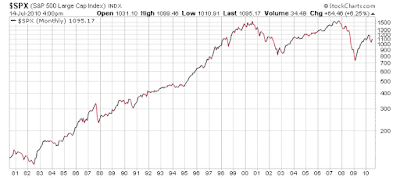
 The chart above shows the performance of the S&P 500 index over the past 10 years. You can see that while the “buying” part might be easy, it’s the “holding” part that can test your nerves.