Showing posts with label performance. Show all posts

Monday, September 8, 2014

What Would You Say You 'Do' Here?

One of my favorite scenes in the movie Office Space is when Tom Smykowski is interviewed by the consultants hired to help Initech downsize. During the interview it becomes painfully obvious that his position isn't necessary. When he's finally asked point blank, “What would you say you do here?”, Tom replies, “…I have people skills! I am good at dealing with people! Can’t you understand that?!?

As an investor it’s important to look at each of your holdings like a consultant and ask what it’s doing in your portfolio. Each investment should have a clearly identifiable role in the overall risk/return of your portfolio. This post covers some of the asset classes commonly used in portfolios to see what they might do to affect a portfolio's return potential.

The portfolio mixes discussed are for educational purposes only and are not recommendations. The portfolios are divided evenly between the investments used in each example and are rebalanced annually.

US Stocks

I tend to think of large-cap US stocks as the first building block of an investment portfolio, so that’s where I’ll start. An investment in Vanguard 500 Index (VFINX) — a mutual fund designed to track the S&P 500 index, one of the more popular benchmarks for large-cap US stocks — would have earned an annualized return of 7.66% for the 10-year period ending June 30, 2014.

The next asset class we might consider adding to our portfolio is small-cap US stocks. Although they tend to be more volatile, stocks of smaller companies have historically outperformed large-cap stocks.

One of the more cost-effective ways to add small-cap stocks to your portfolio is to use a mutual fund that invests in the entire US stock market like Vanguard Total Stock Market (VTSMX) instead of using a separate small-cap stock fund. The average annual return of Vanguard Total Stock Market was 8.31% for the 10-year period ending June 30, 2014, which is 0.65% more per year than Vanguard 500 Index.

International Stocks

Although they’ve underperformed US stocks recently, as a long-term investor it’s a good idea to consider having international stocks in your portfolio. Not only could you benefit during times when international markets outperform the US market, but you could also benefit from international investments if the dollar declines against other currencies. For this asset class I’ll use DFA Large Cap International (DFALX) which invests in large-cap stocks in developed international countries.

Moving 50% of our portfolio to DFA Large Cap International and keeping the other 50% in Vanguard Total Stock Market for large- and small-cap US stock exposure would have earned 7.80% per year from June 2004 through June 2014. Although this mix produced a lower return than Vanguard Total Stock Market by itself, splitting your portfolio evenly between these two funds did produce better results than only holding an S&P 500 index fund over the same timeframe.

Emerging Market Stocks

Emerging markets like Brazil, India, and China don’t always move in lockstep with developed markets, so adding emerging market stocks could be a great way to diversify your portfolio. For this asset class I'll use DFA Emerging Markets (DFEMX).

A portfolio with one-third in Vanguard Total Stock Market, one-third in DFA Large Cap International, and one-third in DFA Emerging Markets would have averaged 9.45% per year through June 2014. This is 1.14% more per year than Vanguard Total Stock Market and a whopping 1.79% more per year than Vanguard 500 Index!

Real Estate Investment Trusts (REITs)

Many investors consider REITs to be an important addition to a portfolio. The historical return from REITs has been similar to large-cap US stocks, but REITs offer great diversification benefits since they don't move in tandem with the overall stock market.

Moving 25% of your investment assets to Vanguard REIT Index (VGSIX) — while holding 25% in US stocks, international stocks, and emerging market stocks — would have increased our theoretical 10-year average annual return to 9.76%. That’s quite a boost over a portfolio of only large-cap US stocks!

Value Investments

The last thing I’d like to do to our hypothetical portfolio is to add separate holdings for US and international small-cap value stocks. For domestic small-cap value stocks I’ll use DFA US Small Cap Value (DFSVX) and for international small-cap value stocks I'll use DFA International Small Cap Value (DISVX).

Just like small-cap stocks offer a higher return potential than large-cap stocks, value stocks have historically outperformed the market as a whole. But in order to capture the potentially higher returns from small-cap and value stocks, you have to be patient enough to hold them for the long-term. And this can be difficult to do when other segments of the market are outperforming value stocks.

So our final theoretical portfolio is evenly divided between Vanguard Total Stock Market Index, DFA Large Cap International, DFA Emerging Markets, Vanguard REIT Index, DFA US Small Cap Value, and DFA International Small Cap Value. This mix would have generated an average annualized return of 9.91% from June 2004 through June 2014, surpassing all of the other mixes we've discussed.

You can see that each of the mutual funds in this hypothetical portfolio serves a specific purpose. They each each represent a specific asset class — or a segment of the market with higher potential return in the case of DFA US Small Cap Value — and mixing them together is a way to have something that “zigs” when other holdings “zag.”

Don’t make the mistake of thinking that you’re diversified just because you have several different holdings. Take time to review each investment you have and ask, “What would you say you do here?”

To learn more about our company - and find out how we are different from other financial advisors - call (210) 587-6433 or visit www.VannoyAdvisoryGroup.com.

Investments mentioned in this post and throughout this blog are for educational purposes only and are not recommendations. Seek investment advice from your personal financial advisor before making any investments.

Monday, August 2, 2010

Is Buy and Hold Dead?

Adherents to a “buy and hold” investment strategy believe that the best way to invest is to hold a diversified portfolio of different asset classes over a long time frame. Here is a simplification of the buy and hold investment process:

1. Analyze your goals, risk tolerance, time horizon, etc.,
2. Select an appropriate asset allocation (mix of asset classes),
3. Select individual investments to use for each asset class,
4. Regularly rebalance your portfolio back to the original asset allocation, and
5. Change the asset allocation as your goals, time horizon, etc. change.

The problem with buy and hold - as with any investment strategy - is that there are times when it doesn’t work. Even with all dividends reinvested, a $10,000 investment in theS&P 500 on March 24, 2000 would only be worth $8,510 as of July 12, 2010!

That’s the kind of performance that has many people declaring that buy and hold is dead.

Performance of the S&P 500 Index*
(10 Years Ending 7/14/10)
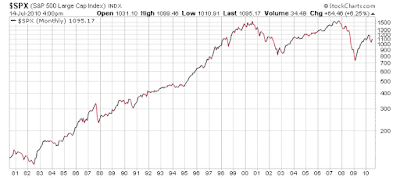
The chart above shows the performance of the S&P 500 index over the past 10 years. You can see that while the “buying” part might be easy, it’s the “holding” part that can test your nerves.
Believe it or not, even though the S&P 500 is still in negative territory, other asset classes have had positive growth over the past decade. A properly diversified portfolio with exposure to US small-cap, developed international, and emerging market stocks, bonds and REITs would have realized positive returns over the past 10 years.*

Even if you had only invested in the S&P 500 over the past 30 years - a strategy I certainly wouldn’t recommend! - you would have still made money if you had been patient enough to ride out the ups and downs. The chart below shows the S&P 500 index over the past 30 years.

Performance of the S&P 500 Index*
(30 Years Ending 7/14/10)

Many people view the negative performance of the S&P 500 over the past 10 years as proof that buy and hold will never work again. This viewpoint is shortsighted, in my opinion, because no single investment strategy can be expected to outperform all of the time.

In fact, buy and hold actually worked over the past 10 years for asset classes other than large US stocks. The moral of the story is to hold a diversified portfolio with multiple asset classes, rebalance regularly, and avoid bailing out at the first sign of trouble.

Buy and hold is an excellent strategy as long as you are aware of, and comfortable with, the pros and cons associated with it.

To learn more about our company - and find out how we are different from other financial advisors - call (210) 587-6433 or visit www.VannoyAdvisoryGroup.com.

*The performance figures and charts in this post are for informational purposes only. Past performance can't and shouldn't be used to predict future returns.

Saturday, July 11, 2009

Top Myths About Investing

Myth 1: Investing is too risky.

Investing in the stock market - and, to a lesser extent, in the bond market - can be risky, especially if you don't know what you're doing! However, not investing in stocks and bonds can be just as risky.

For example, vehicles that most investors consider safe – like savings accounts, CDs, and fixed annuities – don’t keep up with inflation over long time periods. This makes it virtually impossible for most people to save enough in these types of accounts and investments to accomplish big financial goals like retirement.

For large financial goals that are years away, investors need to consider the growth potential of stocks. But, to reduce stock market risk, it's important to diversify stock holdings using vehicles like mutual funds and exchange-traded funds (ETFs) that follow sound investment strategies.

Myth 2: My advisor can help me pick the best investments.

Be leery of any advisor that suggests he or she can pick investments that will outperform the market. The investments recommended by many advisors carry high expenses and commissions that can lower your investment return, and an active trading strategy can lead to a higher tax bill.

If you would like help picking or managing investments, look for a fee-only advisor that doesn't make a living 'selling' investments. Fee-only advisors charge fees for advice, meaning that they don't have incentives to recommend an investment unless they believe it is the absolute best option for you.

Two organizations that represent fee-only advisors are the Garrett Planning Network (www.GarrettPlanningNetwork.com) and the National Association of Personal Financial Advisors (www.NAPFA.org).

Myth 3: Investment performance is the most important factor to help me reach my goal.

Investment performance is important, but you should place primary importance on the things you can control. The first thing you can control is the amount you save. Saving and investing more will increase the chance you'll reach your financial goal. Second, you should focus on controlling costs. Higher cost investments often underperform over time. And third, always follow a clearly defined investment strategy rather than basing your investment decisions on tips from friends or your hunches.

Myth 4: I need to be in a hedge fund to make money.

Hedge funds have three “highs” that make them unsuitable for most investors: high minimums, high costs, and a high failure rate. It’s not uncommon for the minimum investment to be $1M or more, and once in the investment you’ll often pay expenses of 2% per year plus 20% of profits. As far as the failure rate, a study by the European Central Bank found that some hedge fund strategies have annual failure rates of over 14% per year.

While it's not as sexy and exciting as a hedge fund, a diversified portfolio of low-cost mutual funds and ETFs that has a mix of stocks and bonds is best for most investors.

Myth 5: Smart investors buy gold.

Gold gets a lot of attention during times of market volatility. Gold doesn't pay dividends, so any potential return will be from 100% price appreciation. So for an investment in gold to be profitable, you have to buy it in advance of market volatility before the price has risen. And if the price of gold drops, you won't receive any dividends to help cushion the fall.

While gold can be a good short-term hedge, historically it’s been a horrible long-term investment and at times it has been much more volatile than the stock market. At most, gold is a short-term speculative investment and most people are fine without it.

Myth 6: I’m too young to start planning for retirement.

Actually, the earlier you start the better because your investments will have more time to compound and grow, making it much easier to reach your goal. If you wait too long, you might end up having to rely on Social Security and lower your ideal standard of living in retirement. So follow our motto: "invest early, invest often".

To learn more about our company - and find out how we are different from other financial advisors - call (210) 587-6433 or visit www.VannoyAdvisoryGroup.com.